What AI Can Fix in Rural Schools
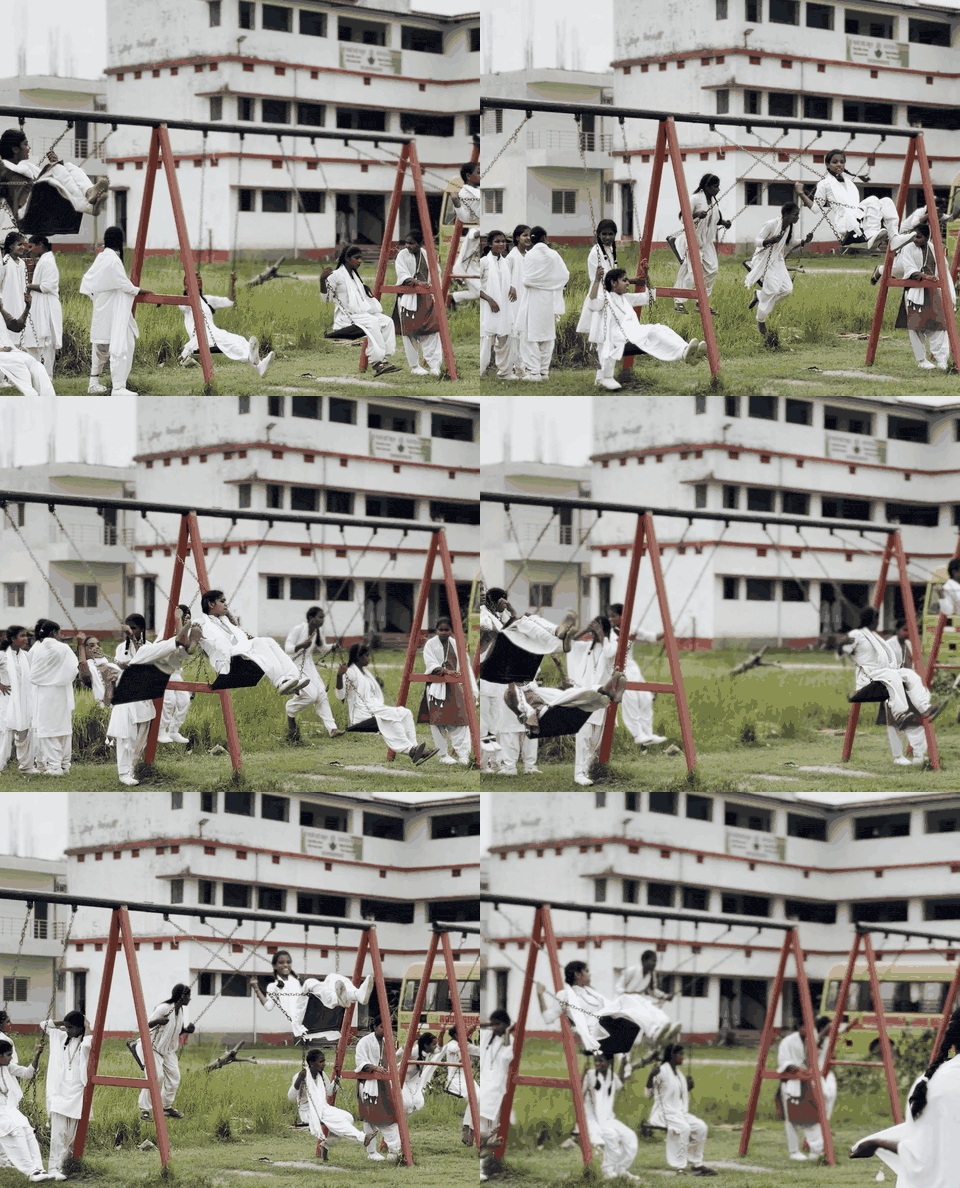
For the last two months I have been working with a school in West Champaran, in the middle of farmland, close to the Nepal border. There are a few houses fifty metres from the gate, but the actual village is a kilometre and a half away. On a clear morning you can see the mountains from the campus. This post is what I have seen from that one place, so take it for what it is. But I don't think the problem I am describing is only ours.
The inputs are not the problem
The first thing you should know is that this school has almost everything people say a rural school needs.
Smart classrooms. A computer lab. A library. Two or three blocks with enough rooms. Solar backup, so power is not an issue. A school bus. A guard on the gate at all hours. There is a residential building on campus with proper facilities, and some of the teaching and non-teaching staff live there. Others ride in from nearby, a few walk over.
I am saying this upfront because the usual conversation about rural education is about inputs. Build toilets, add rooms, give electricity, put a screen on the wall. Those things matter. But a school this well equipped is rare in this part of the state, and even here the outcome for our girls is not what it should be. So the inputs argument is finished, at least on this campus, and something else is going on.
That is why I want to use this school as a test. If the problem still exists in a school that has all of this, it exists everywhere below it.
The part that is not solved is people. The school hires the best it can find in this area, and it tries hard. But the ones with real qualifications do not stay long. The pay gap between a city and this place is real, and no amount of goodwill closes it.
Government schools nearby pay much better and still have the same gap, because paying more does not create trained people who are not there in the first place. We know a foundation running a school in another district that does manage to hire highly trained teachers. They pay a lot for it. We are trying to learn from them. But the honest summary is that the regional market for skilled teachers is thin, and every school here is drawing from the same shallow pool.
What actually happens after Class 10
Then comes the part that I did not fully understand until I started talking to our students.
This is a girls' school. Parents will not send their daughters to Patna, Kota, Delhi or Hyderabad for higher studies. Whatever a girl studies after Class 10, she has to be able to reach it in the morning and be home by evening. That single condition decides everything.
Inside that radius there are no strong teachers and no serious coaching. The same thin supply that makes hiring hard for us is what she runs into when she looks for a college. So the girls have worked out their own solution. Many of them skip Class 11 almost entirely, because nothing important is examined that year. They wait. Then in Class 12 they study on their own from recorded lectures, Physics Wallah, Disha Online, whatever is available on the phone.
By the time they choose a stream, the choice is already made for them. From what I have seen, only a handful take science. Most take arts. By graduation it is almost everyone in a BA, whatever they were actually good at. And at the end of that, a degree that no employer reads as a signal of anything.
So the problem is not that the school fails to teach. The problem is that there is no pathway after it, and for a girl who cannot travel, no way around that.
Where AI actually helps
Now here is the thing that changed how I think about this.
Our students are already learning from a machine. They are sitting at home with recorded lectures, teaching themselves Class 12 physics from a phone. Nobody designed this. They did it because there was no alternative.
What a recorded video cannot do is answer you when you are stuck. It cannot notice that you misunderstood something in the previous chapter. It cannot tell you what to study next. That gap is exactly where AI is useful, and it is a narrow enough claim that I am comfortable making it.
There are two places this can sit.
One is the school itself. Most schools in India already report having computers, around 65 percent nationally in 2024-25, up from about 58 percent the year before.1 For most of the country this is not an infrastructure ask, it is an activation ask. One capable machine, ideally running a model locally so connectivity and cost stop being excuses, becomes a way to train and support teachers. Lesson prep, worked examples, explanations in Hindi. Where the smart boards are already on the wall, put something useful behind them. That hardware is already paid for.
The second is the phone. This is the one that matters more, because it does not depend on the school having anything. The girl studying alone at nine at night needs something she can ask, in Hindi, when she is stuck. That works whether or not her school has a lab.
And Bihar is exactly why the phone route matters. Only about a quarter of schools here have computer facilities, 25.2 percent against 64.7 percent nationally in 2024-25, and in government schools it drops to 16.5 percent.2 Internet was around 18 percent the year before that.3 Waiting for the school to be equipped is not a plan.
There is one more thing worth mentioning, and I offer it as an example rather than a prescription. On this campus we run a programme that trains local girls in English, computers and AI tools. If it works, the school will be able to hire from the village instead of losing another qualified teacher to a city. That is a slower thing than either of the above, and a bigger one. It changes who is available to hire, rather than working around the shortage. We call it School to Livelihood.
What it will not fix
I want to be clear about the limits, because I have seen enough technology arrive in schools and do nothing.
The phone is not ours. We do not control who owns it in the house, or whether a girl gets time alone with it. In many homes it belongs to a brother or a father.
A model that is confidently wrong is worse than no model, especially for a student studying alone with nobody nearby qualified to catch the mistake.
These tools are still much weaker in Hindi than in English, and weaker again in Bhojpuri. Which means the child furthest from English gets the worst version of the product. That is the wrong way round.
And the biggest one. AI does not create a science stream within reach. It does not build a college in the block. It does not produce an employer. It works around the pathway problem, it does not solve it.
So no, AI will not fix rural schools. But for a girl teaching herself Class 12 from a phone, in a village where there is nobody to ask, it can make her a lot less alone in it. From what I have seen so far, that is worth doing.
UDISE+ 2024-25, Ministry of Education. Computer availability rose to 64.7 percent from 57.7 percent, and internet connectivity to 63.5 percent from 53.9 percent. Report booklet.
UDISE+ 2024-25, as reported by ThePrint, 29 August 2025.
UDISE+ 2023-24 state-wise analysis, Education for All in India.